
Ep. 517 Bob Murphy Asks: Why Did I Lose My SoHo Forum Debate on Fractional Reserve Banking?
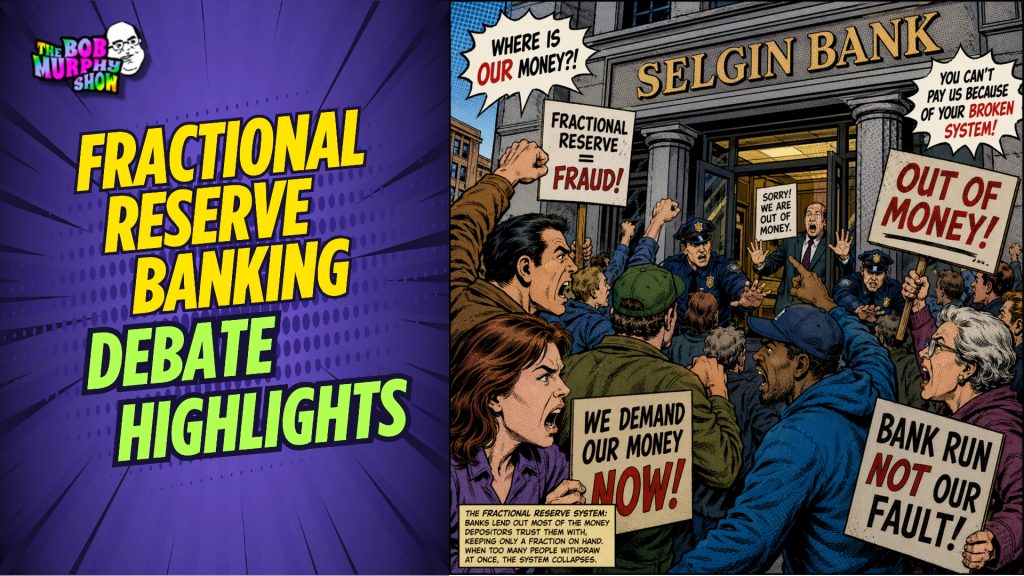
Adam returns to tell Bob why he lost his debate to George Selgin.
Mentioned in the Episode and Other Links of Interest:
- The YouTube version of this episode.
- The SoHo Forum debate between Murphy and Selgin.
- This episode’s sponsor, the free Plan-B guide from ExPatMoney.
- Bob’s article on FRB.
- The HamanNature substack.
- Help support the Bob Murphy Show.

About the author, Robert
Christian and economist, Chief Economist at infineo, and Senior Fellow with the Mises Institute.
I so much enjoyed this episode as well as the Soho Forum debate, which I went back and watched. In defense of Bob, if I was at the forum, I would have voted in the beginning with George, and then at the end with Bob. I always thought FRB is not a real problem if properly disclosed and when every bank can choose how much reserve they have (or additionally, how much owner’s equity capital they are willing to lose in a bank run).
Where Bob made me think twice is the old adage of a dollar in the checking account being treated the same as a dollar in the hand. There is just no good mechanism of valuing checks or debit-card payments lower than cash. Yes, I might get a 3% discount for paying cash, and a lot of vendors might not accept a check (maybe even depending on the institution). But in a bank run, the first customers get it all, and subsequent customers might have to wait for the bank’s loans getting paid back to recover their money. This is a real asymmetry. I would have to spread my funds across many institutions, and only have a fairly constant amount in my accounts, defeating the purpose of efficiency.
Thanks Reinhard!
Here’s my take. First, Hoppe is right that FRB is fraudulent. Second, FRB seems like a free lunch. Proponents claim FRB offers various benefits over 100% reserve banking. But to actually “do” FRB, you merely change numbers on a computer, so there is no opportunity cost there. If proponents also claim there is no inherent instability, then they seem to be claiming FRB can give benefits with zero opportunity cost.
Also, Bob, here is my friendly, hopefully constructive 2 cents. Your speaking voice is pretty compressed. I’m not talking about loudness versus quietness but rather compressed versus soft-spoken. There are people who I would describe as soft-spoken while still speaking at a normal loudness level. Someone that comes to mind is Johnny Carson, but you can probably think of other examples (Ronald Reagan?). Listening to people like them talk instinctively relaxes you and puts you at ease, but a compressed voice kind of does the opposite. And I believe those claims that say a large majority of communication is nonverbal ie tone of voice and body language.
I’m no voice expert, but maybe the issue is that you are holding a lot of muscle tension. Maybe tension in your chest / lung / abdomen area, or throat / temple / forehead.
Thanks, those are fair points.
Unfair and not a point: like saying “you’d be more convincing without that French accent,”
I think it’s fair. Professional singers/actors/TV anchors do all sorts of different voice exercises, every day, to improve their voice.
I think it’s a point. Nonverbal stuff affects the audience’s state of mind. Someone in a relaxed state of mind can listen and process the logic of your argument more easily.
> First, Hoppe is right that FRB is fraudulent
Let’s try to distinguish between as-practiced and the theoretical case. Would FRB be fraudulent if, before entering the contract, the nature of the operation and the inherent and specific risks were communicated to the customer? Clearly not. So FRB could be implemented in a non-fraudulent manner.
It’s a bit like a computer sold with a remote-controlled operating system. I find this objectionable and fraudulent. My expectation as owner of a computer is that I control all the processing it does. That’s not possible with Microsoft, since 30+ years. Nobody at Mises has a problem with that because they don’t understand it. The debasement of property has been normalized, just like FRB, and none of the Misesians has the remotest sense of violation here. Slowly some twitch to dim awareness… 30 years too late.
> Second, FRB seems like a free lunch
Agree that many economists sell it as if it is.
I agree with the people who say FRB is analogous to someone selling a square circle. It doesn’t matter if both parties are fully aware of the “contract” because a square circle is a logical contradiction, and hence I’d say the “contract” is not valid.
If I sell you an investment and disclose that it is just a Ponzi scheme, is it still fraudulent? Of course it is.
Look at the resolution precisely people:
“Fractional Reserve banking poses a threat to the STABILITY of market economies.”
The question doesn’t include a normative judgement on ‘stability’ as good or bad. It’s a simple question of STABILITY, in the sense of a system being MORE OR LESS STABLE.
Fractional reserve banking proponents argue that it allows banks to expand the money supply ‘DYNAMICALLY, AS NECESSARY’. BY THEIR OWN ARGUMENT, it is LESS STABLE, LESS CONSTANT a money-supply. The Positive side (Murphy) just needs to point this out, while the negative side HAS to show that a more synamic money supply leads to more stable economic activity elsewhere. A very tough sell.
Of course NOT ONE IN TEN AUDIENCE MEMBERS UNDERSTOOD THIS.
The ENEMY has EXTERMINATED RATIONAL THOUGHT.
Wow look at that demon turd Selgin’s tactics.
NOTICE THE DEMONIC MENTAL MANIPULATION.
1) Starts out with “after that comedy” -> inferring bob’s whole point was a comedy.
2) CASTS IT TO EMOTIONAL -> “I have to defend bankers, feel sorry for me”
3) COLLAPSES bob’s educational and undistuted opening remarks to imbecility “he call s them bad”
Goes to MISCASTING THE RESOLUTION.
“I have to say fractional reserve isn’t harmful to the economy”
LIAR LIAR LIAR
THE RESOLUTION WAS ABOUT THE STABILITY OF THE ECONOMY. STABILITY. STABILITY.
THIS DEMON SQUAT!!
Dr. Murphy’s constructive was absolutely best-in-world.
Bob also emphasized the key in the resolution: “stability” (though i’d have done it differently). Excellent focus.
Also pointed out what his opponent did not respond-to. An impartial policy debate judge would have scored for bob and deranked Selgin.
Bob won the debate, objectively.
Debate not findable with: google, ddg, yandex
Debate not findable on the reason youtube channel
Debate not findable on Bob Murphy’s youtube chanel
https://www.youtube.com/@BobMurphyAncap
Debate not findable on the soho forum
https://www.thesohoforum.org/past-events
Debate not findable.
WHAT????????????????????????????????
I linked to the YouTube of the debate in the second bullet point above, so not sure why you’re having trouble finding it. If I go to YouTube and search “Soho forum murphy selgin” it pops up, but maybe that’s because I’ve brought it up so much over the years (since I link to it a lot).